
Introduction
Chemicals play a vital role in industrial development, agriculture, healthcare, and everyday products. However, their benefits come with potential risks to human health and the environment if not properly managed. Understanding and controlling these risks is essential for ensuring safe chemical use and preventing harmful impacts. This is where chemical risk assessment and risk management become critical components of modern environmental governance.
The Gray2GreenEnvironment platform aims to raise awareness and provide knowledge on chemical safety and hazardous waste management. Through this blog, readers can understand how risks associated with chemicals are identified, evaluated, and controlled to ensure safety across their entire lifecycle.
1. What is Chemical Risk Assessment?
Chemical risk assessment is a scientific process used to evaluate the potential adverse effects of chemical exposure on human health and the environment. It helps regulators, industries, and policymakers make informed decisions about how chemicals should be produced, used, and managed safely.
This process involves analyzing both the hazardous properties of a chemical and the level of exposure to it. Risk assessment is essential because even a highly hazardous chemical may pose low risk if exposure is controlled, while a less hazardous chemical can become dangerous if exposure is high or uncontrolled.
2. Key Steps in Chemical Risk Assessment
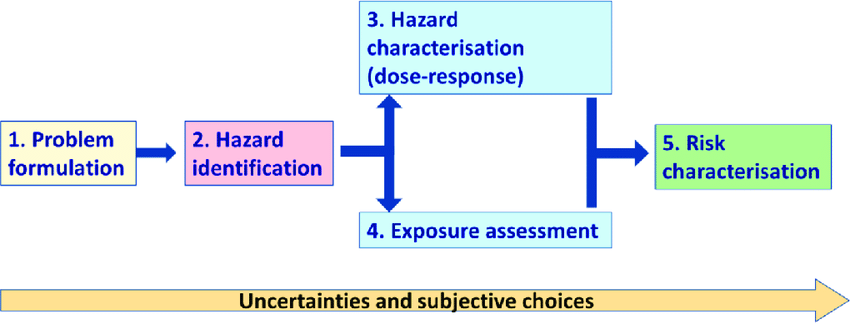
Chemical risk assessment follows a structured, stepwise process to evaluate the potential impacts of chemicals on human health and the environment. It begins with problem formulation, where the scope, objectives, and context of the assessment are clearly defined. This is followed by hazard identification, which involves determining whether a chemical has the potential to cause harmful effects. The next step, hazard characterization (dose-response assessment), examines the relationship between the magnitude of exposure and the severity of adverse effects. In parallel, exposure assessment evaluates how, how much, and how often humans or environmental receptors are exposed to the chemical.
Finally, all this information is integrated in risk characterization, where the likelihood and severity of adverse effects are estimated. Throughout the process, uncertainties and subjective judgments may arise, highlighting the importance of using scientific evidence and transparent decision-making in chemical risk assessment.
3. What is Chemical Risk Management?
Chemical risk management involves the actions and strategies used to control or reduce risks identified through the risk assessment process. It focuses on minimizing exposure to hazardous chemicals and ensuring that their use does not pose unacceptable risks to health or the environment.
Risk management measures may include regulatory controls, engineering solutions, safe handling practices, and the use of protective equipment. It also involves setting limits, standards, and guidelines for safe chemical use in different sectors such as industry, agriculture, and consumer products.
4. Tools and Approaches for Risk Management
Various tools and approaches are used to manage chemical risks effectively. Regulatory frameworks establish legal requirements for chemical production, labeling, and disposal. Systems such as the Globally Harmonized System help communicate chemical hazards clearly, while Safety Data Sheets provide detailed information on safe handling and emergency measures.
Other approaches include substitution of hazardous chemicals with safer alternatives, adoption of cleaner production technologies, and implementation of pollution control measures. Lifecycle management and Extended Producer Responsibility also contribute to reducing chemical risks throughout product value chains.
5. Importance of Risk Assessment in Policy and Industry
Chemical risk assessment plays a crucial role in shaping environmental policies and industrial practices. Governments use risk assessment to develop regulations, set exposure limits, and control hazardous substances. Industries rely on it to ensure compliance, improve safety practices, and reduce liabilities.
Effective risk assessment also supports international frameworks and agreements aimed at improving chemical safety worldwide. It helps countries align with global standards and ensures that chemical risks are managed consistently across borders.
6. Challenges in Chemical Risk Management
Despite its importance, chemical risk management faces several challenges, particularly in developing countries. These include limited availability of chemical data, lack of technical expertise, weak regulatory enforcement, and insufficient coordination among institutions.
Rapid industrialization and the introduction of new chemicals further increase the complexity of risk assessment. Addressing these challenges requires investment in capacity building, data systems, research, and institutional strengthening to ensure effective chemical governance.
7. Opportunities for Strengthening Chemical Safety
There are significant opportunities to improve chemical risk management through better policies, technologies, and international cooperation. Strengthening chemical data management systems, promoting transparency, and enhancing stakeholder engagement can lead to more informed decision-making.
International frameworks such as the Global Framework on Chemicals encourage countries to adopt integrated approaches to chemical management. By aligning national systems with global standards, countries can improve safety, support sustainable development, and protect public health and the environment.
8. Conclusion
Chemical risk assessment and risk management are essential tools for ensuring the safe use of chemicals in modern society. By identifying hazards, evaluating risks, and implementing appropriate control measures, these processes help prevent harm to people and the environment.
As chemical use continues to grow, strengthening risk management systems becomes increasingly important. Through awareness, policy development, and stakeholder collaboration, it is possible to achieve safer chemical management and contribute to a more sustainable and healthy future.
0 Comments